Friday, July 1, 2011

The All-New ParkZone Ultra Micro Series Pole Cat Pylon Racer

ParkZone’s first Ultra Micro Series Formula 1 airplane, the Pole Cat, is a slippery little racer that you can fly just about anywhere!


The Ultra Micro Series Pole Cat BNF is modeled after the modified Cassutt Formula 1 air racers that compete in the world famous Reno Air Race. It's been specially designed to deliver all the looks and thrills of these compact speedsters, yet remain as forgiving as any sport plane. Designed with personalization in mind, the Pole Cat comes with decal options so racers can distinguish their plane as they speed through an ultra micro pylon race.

Features:
  • Spektrum AR6400 DSM2 receiver/ESC unit
  • 4-channel control – throttle, aileron, elevator and rudder
  • Spektrum AS2000L ultra micro aileron servo
  • 8.5mm coreless brushed motor
  • Tail wheel steering
  • Attractive paint scheme
  • Race number decal sheets
  • Race number decal sheets
  • 1S 150mAh Li-Po battery and DC charger

Introducing the Cessna 150 Aerobat 250 ARF by E-flite


The Cessna 150 Aerobat 250 is for RC pilots wanting the thrill of basic aerobatics in a small yet detailed package. This clever, all-wood model remarkably maintains the subtle curves and character of the original aircraft, yet is distinctively tricked out with a checker-scheme that honors the character of the Aerobat.


Features:
  • Authentic scale outline and lightweight UltraCote® ParkLite™ trim scheme
  • Balsa construction with fiberglass cowl and wheel pants
  • Laser-cut engineered to be as light as possible
  • Magnetically secured plug-in wings and cowl
  • Clear front, rear, side and skylight windows
  • Pre-hinged ailerons and rudder controls
  • Easily assembles in a single evening
  • Easy access hatch with spring-loaded latch
  • Quick release struts
  • E-flite aluminum spinner available separately (EFLSP100)
  • Recommended for use with the New Park 280 Motor (EFLM1140)
  • Recommended for use with the New 3.5-Gram DS35 Digital Super Sub-Micro Servo (EFLRDS35)

Announcing the NEW Parkzone Spitfire Mk IX

ParkZone brings the Spitfire Mk IX to life with this accurate representation and powerful motor, battery and propeller combination. From the radiator scoop, 20mm gun barrels and cannon blisters to the exhaust ports and detailed cockpit area, this Spitfire has it all. For added authenticity, the trim scheme is modeled after famed RAF ace Johnnie Johnson. Available in BNF and PNP versions, the ParkZone Spitfire Mk IX comes out of the box with 4-channel control and fixed landing gear but is ready to accept E-flite® .15-size electric retracts.
  • 4-channel control – throttle, elevator, aileron and rudder
  • Powerful 15- sized BL outrunner; 950Kv, installed
  • E-flite® 30A Pro Switch-Mode BEC brushless ESC, installed
  • Servos, installed
  • Dual aileron servos for precise control
  • Designed to accept E-flite electric retracts (EFLG100), sold separately
  • Durable Z-Foam™ construction
  • 20mm cannon, exhaust and cockpit details
  • Authentic Johnnie Johnson World War II trim scheme

Visit the Modelflight Website for more information


Friday, June 17, 2011

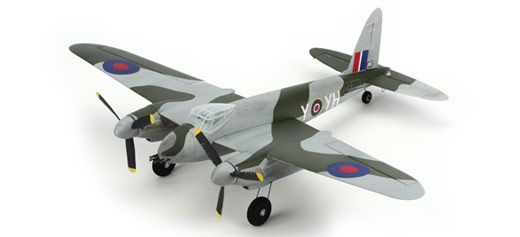
How to Add Scale Weathering to Your Ultra Micro War Bird


Ultra Micro warbirds are one of the latest fun crazes in the RC Hobby. Flying in the backyard with buddies to a full mock battle over the grass, these gems make evening flying a thing of beauty. The only real issue is that they all look like small little models that are new from the factory. That wasn’t how it was back in the big war. They were battle-proven and well used. Our warbirds need some weathering on them!

It isn’t hard to weather, and we’ll show you how to do it. Using the Ultra Micro Mosquito, we turn a fresh-from-the-factory looking warbird to a plane that saw some serious action on the battle front. All it takes is some pastel chalks, a few paint brushes and some flat clear coat. Before long, you will find your warbird looking like the real deal and your friends will be so amazed they’ll ask how you did it.

ParkZone Ultra Micro Corsair Review


It was an icon of U.S. military might during WWII – a weapon so devastating its foes referred to it as “Whistling Death”. Now the F4U Corsair is making a name for itself as the latest ParkZone Ultra Micro Series scale warbird that you can fly just about anywhere.

We meet with Seth Arnold, the Product Developer on the Corsair to see what has come to life in this new Ultra Micro model. Scale details include a three bladed propeller, authentic paint scheme, molded clear plastic canopy, landing gear with steerable tail wheel, and even two sets of decals. The 4-channel control with elevator, throttle, rudder and aileron provide full control for precise flying and maneuverability. So take a look and get ready to order yours today.

Wednesday, June 15, 2011

Announcing DMSS and the JR XG8 from JR Propo

Modelflight is very excited to announce JRs truly 'state of the art' entry into the 2.4GHz market; DMSS and the XG8!

The brand new eight-channel XG8 DMSS radio will be released in Australia on June 15th. 


The XG8 Radio will be offered as a combo, including anXG8 transmitterand a RG831B (with RA01T remote) telemetry enabled receiver. 

The XG8 is the first JR transmitter to come with a LiFe battery, being fitted with a 2S 1400mAh LiFe pack. This has greatly reduced the weight of the transmitter, which weighs in at only 770 grams. It also ensures perfect balance and no compromise to the great JR ergonomic design. The transmitter has an integrated charging circuit so just plug in the suppliedAustralian Compliant AC adapter and the charging unit will shut down automatically once it detects that the battery is fully charged. No more worries about overcharging!


The XG8 offers Aeroplane, Helicopter and Glider modes, a 30 model internal memory, stick modes 1 to 4 and an SD card slot for model data sharing, expanded storage and software updates (SD card not supplied). 

Programming is easy thanks to JR’s well-proven, intuitive user interface with data entered using the familiar scroll bar and four push-button entry keys. The programming information is clearly displayed on the large, graphical back lit screen. 

XG8 uses the new JR DMSS 2.4 technology which, besides offering a secure, robust radio link to control your models, also offers advanced telemetry functions and JR’s new Intelligent Output System. Receiver voltage telemetry is built in as standard and other forthcoming add-on sensors will give you real time feedback of information from your model such as the RPM of an aircraft propeller or helicopter rotor blades, temperature and variometer/altimeter readings. 

JR’s Intelligent Output System automatically selects control signals that need to be transmitted at exactly the same time and transmits the data for these channels as one complete signal frame. This ensures that there is no time delay when commanding servos used for critical functions such as a CCPM swash plate on a helicopter or when operating a four servo aileron wing.

Other features include side-lever controls on either side of the transmitter, a Touch Select System for switch selection, dual trim options, a user selected menu for frequently used functions, failsafe on all eight channels, user assigned switch function, programmable throttle cut and two independent programmable timers.


What is JR DMSS?
Dual Modulation Spectrum System is JR’s own 2.4GHz protocol. A later entrant into the 2.4GHz market, DMSS can be considered as the truly ‘state of the art’ method of providing radio control for model use.  And since JR have not rushed their own 2.4GHz protocol into production they have been able to incorporate the very latest techniques for ‘Wideband Data Transmission’ into the next generation of JR radio control sets.

DMSS combines the best features of Frequency Hopping Spread Spectrum (FHSS) and Direct Sequence Spread Spectrum (DSSS) protocols. FHSS is great for avoiding interference and DSSS offers high response. JR DMSS combines both these attributes, having both frequency hopping and high response.

The JR DMSS system uses a greater than 3Mhz wide signal as compared to the majority of others which utilise a much narrower [1Mhz or less] signal.

If we know anything about spread spectrum signals, a wider base signal [3Mhz Vs 1Mhz] allows for a huge increase in noise and interference immunity performance and at the same time allowing for much faster data bandwidth/throughput.

The fact that DMSS is actually using quite a wide bandwidth signal is a huge advantage in 2.4GHz performance and it will provide superior performance over any other current 2.4GHz system that is currently available.

DMSS also offers ‘Two-Way Communication’ (telemetry) with receiver voltage monitoring as standard. Other types of sensor are due soon, with Temperature and RPM sensors being the next types to become available from JR in late June.

Probably the most important thing about JR DMSS is that it is 100% pure JR, with no involvement from any other outside company. This means that JR are back in full control of product development, so they can now concentrate on doing what they do best – making what are arguably the world’s best quality  radio control systems.


Click here to read more on JR's DMSS

What is JR DMSS?

What is JR DMSS?

Dual Modulation Spectrum System is JR’s own 2.4GHz protocol. A later entrant into the 2.4GHz market, DMSS can be considered as the truly ‘state of the art’ method of providing radio control for model use. And since JR have not rushed their own 2.4GHz protocol into production they have been able to incorporate the very latest techniques for ‘Wideband Data Transmission’ into the next generation of JR radio control sets.

DMSS combines the best features of Frequency Hopping Spread Spectrum (FHSS) and Direct Sequence Spread Spectrum (DSSS) protocols. FHSS is great for avoiding interference and DSSS offers high response. JR DMSS combines both these attributes, having both frequency hopping and high response.

The JR DMSS system uses a greater than 3Mhz wide signal as compared to the majority of others which utilise a much narrower [1Mhz or less] signal.


If we know anything about spread spectrum signals, a wider base signal [3Mhz Vs 1Mhz] allows for a huge increase in noise and interference immunity performance and at the same time allowing for much faster data bandwidth/throughput.

The fact that DMSS is actually using quite a wide bandwidth signal is a huge advantage in 2.4GHz performance and it will provide superior performance over any other current 2.4GHz system that is currently available.

DMSS also offers ‘Two-Way Communication’ (telemetry) with receiver voltage monitoring as standard. Other types of sensor are due soon, with Temperature and RPM sensors being the next types to become available from JR in late June.

Probably the most important thing about JR DMSS is that it is100% pure JR, with no involvement from any other outside company. This means that JR are back in full control of product development, so they can now concentrate on doing what they do best – making what are arguably the world’s best quality radio control systems.

How can I get JR DMSS?
DMSS is being built into the next generation of JR radio control sets. DMSS sets can be differentiated from earlier JR 2.4 sets by looking for the XG series nomenclature.

The first XG series radio to Australia will be the XG8 eight-channel system, which is supplied with an RG831 receiver, complete with an embedded Receiver Voltage sensor and the combined satellite receiver/telemetry module RA01T.

The XG8 has passed MAAA testing and is due for release in Australia on June 15th, 2011. Later in the year we expect the radio line-up to extend with a pleasing blend of conventional JR transmitter case design with modern design touches. When picked up and compared with current eight channel sets we think you really will ‘feel the difference’!


If I already own a JR modular transmitter, can I update it to DMSS?
At the time of writing we are still waiting for JR’s instructions on how to deal with requests for DMSS updates. We will post any new information on this topic in the Support pages of our website

Will I be able to use DSM2 receivers with my JR DMSS transmitter?

No. JR DMSS is a completely new 2.4GHz protocol with the combined better features from FHSS and DSSS. DMSS transmitters will not work with earlier 2.4GHz receivers from either JR or other manufacturers.

OK, so now I’m up to speed with JR DMSS. But I’ve heard there is a new version of the earlier DSM2 system that JR previously used. Can you tell me more?
JR’s first 2.4 systems used the DSM2 protocol on licence from Horizon Hobby. DSM2 has recently been updated to DSMX. You can read more about this topic here.

The brand new eight-channel XG8 DMSS radio will be released in Australia on June 15th.